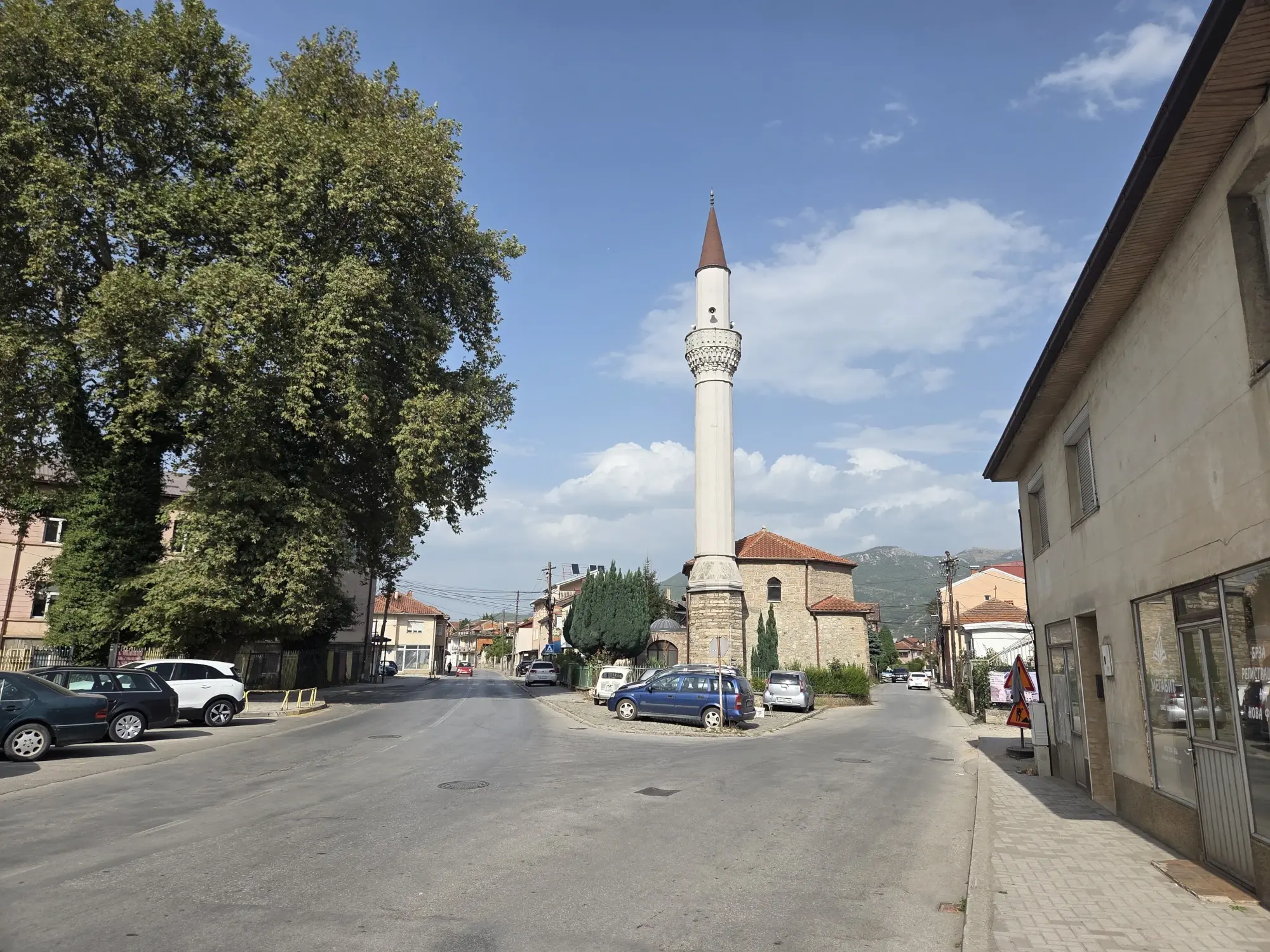
Just north of Ohrid's historic center, almost at the junction of 7th November Street (ul. 7-mi Noemvri) and Marko Nestoroski Street, you will see a modest Friday mosque. Most tourists walk straight past.
Usually, they are heading somewhere else, to the Old Bazaar, the lake, or to a kafana that someone recommended to them.
The mosque gives you few reasons to stop and observe. Square footprint, brick and cut stone held with lime mortar, a low eight-pitched dome covered in Turkish roof tiles, a minaret roughly twenty meters tall.
But look up, and you will notice a small Christian cross on top of it. That detail, a cross in a crescent, is why most people living in Ohrid know the building by name. Locals call it Krst Dzamija, or the Cross Mosque.
The Oldest Mosque in Ohrid
According to most sources, the construction of the mosque finished in 1466, making it the oldest mosque in Ohrid. The period marked the early Ottoman reorganization of the city, less than two decades after the fall of Constantinople in 1453. At the time, mosques were more of statements for the Ottoman rule than places of worship.
The mosque, also known as Haji Turgut (Хаџи Дургут) was built on the site of an older Christian church dedicated to Saint Kyriakia, a Greek martyr venerated across the Orthodox world, her feast day falling on 7 July. Ottomans demolished the church and tried to build a mosque in its place. The minaret went up, but according to most legends, this is where trouble began.
What the Legends Say
There are multiple legends about The Cross Mosque, but the main thing remains the same.
When the Turks raised the minaret, they found a cross at its top, the old cross of the church of Saint Kyriakia, which they had thrown into the lake. They threw it in a second time and the minaret collapsed. Ottomans built the minaret again, and the cross came back. The cycle continued until someone dreamt that the minaret will stand only if the cross was there. So, the Turks placed the cross inside the crescent, and the minaret has stood ever since.
Another legend says that the location itself was the problem. The site had been a crossroads, or a gathering point since before Ottoman rule. According to the legend, the Turks were warned by an elder that unless they put a cross, the minaret would simply not hold. In this version, a living person is the one who instructed the Turks, not a dream.
A Landmark Worth Visiting
Few tourists find their way to Krst Džamija on purpose. In most guidebooks, you will find only a footnote, a one-line between the more photographed sites of the UNESCO-listed town.
But ask any person in Ohrid for directions to almost anything in the northern part of the center, and Krst Džamija is likely to appear in the answer. They will probably tell you “Go past Krst Dzamija, then turn left.”
The mosque is one of those buildings that functions less as a destination than as an orientation point in the city. It is the kind of landmark people name without thinking, because everyone before them knew the name.
The name works as a compass because it is precise. In a city with 365 churches, one at almost every corner, the mosque with a cross needs no further description.
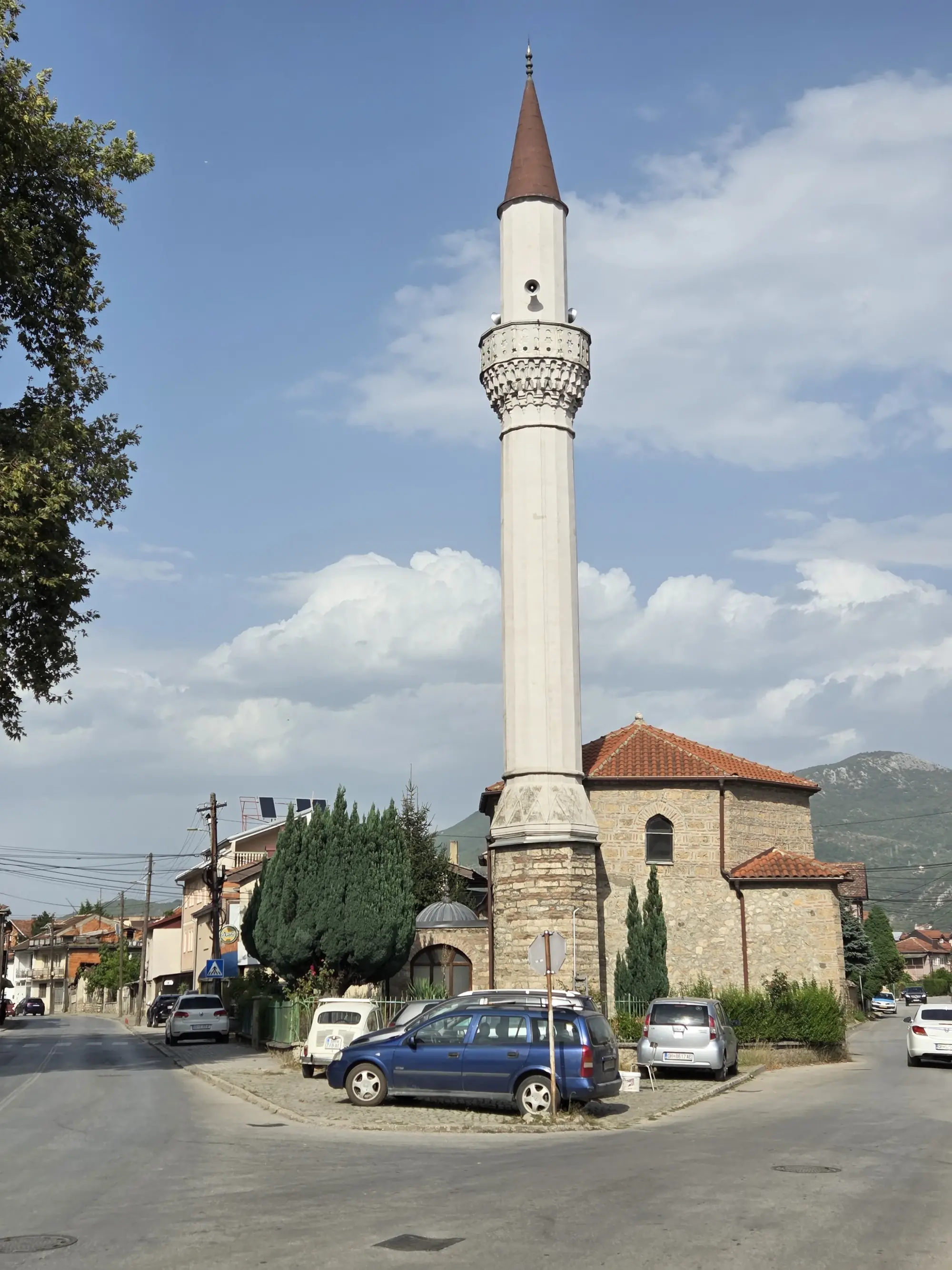
The Building itself
This little-known Krst Džamija, the Mosque With a Cross, reveals more about the complicated history of Islam, Christianity, and power in the Balkans than many history books can in a thousand pages.
The architecture might is not exceptional. But the cross at the top of the minaret is something that refuses to be forgotten.
Ottomans had a practice to build mosques on foundations of churches. What is less common is a mosque where the builders, according to the story that survived six centuries, eventually stopped fighting the symbol they were trying to erase.
Whether the cross was placed there out of superstition, practicality, or a compromise too pragmatic to put in writing, it is there today: a small cross inside a crescent, twenty meters above the street, on the oldest mosque in Ohrid.
You can see it if you look up at the right moment, which most people passing on 7th November Street never do.
Go past Krst Džamija. Then turn left. Or stop, and look up.