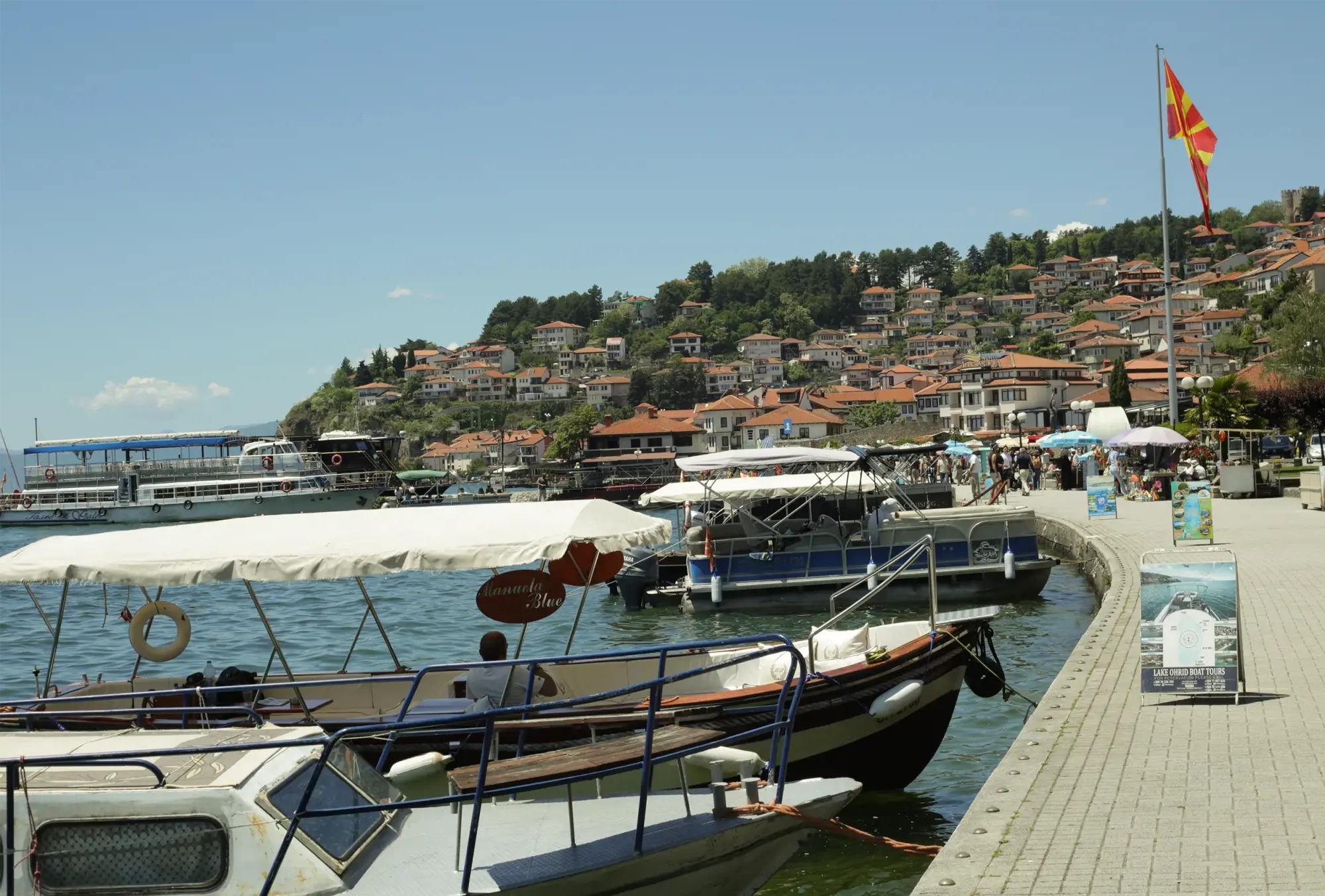
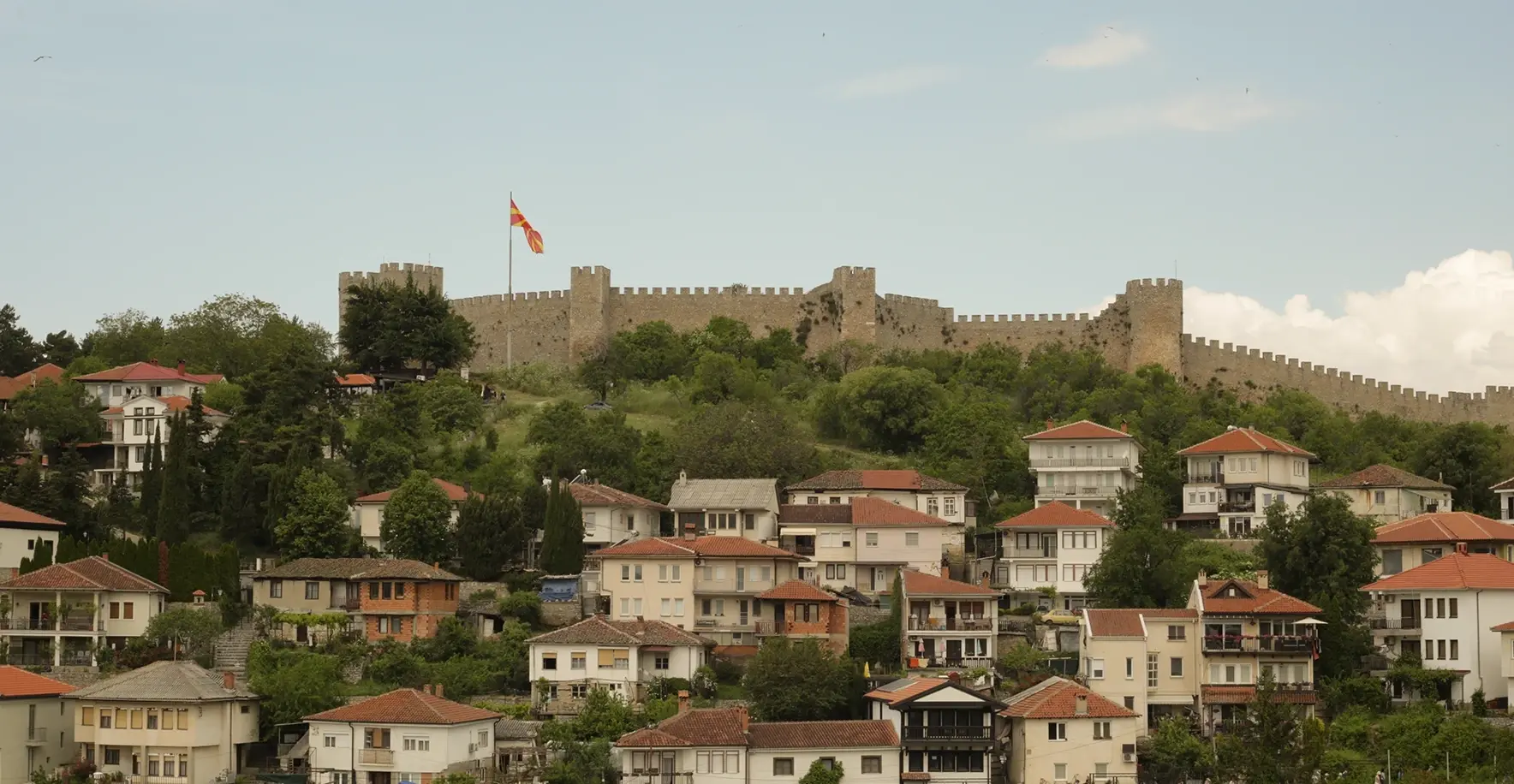
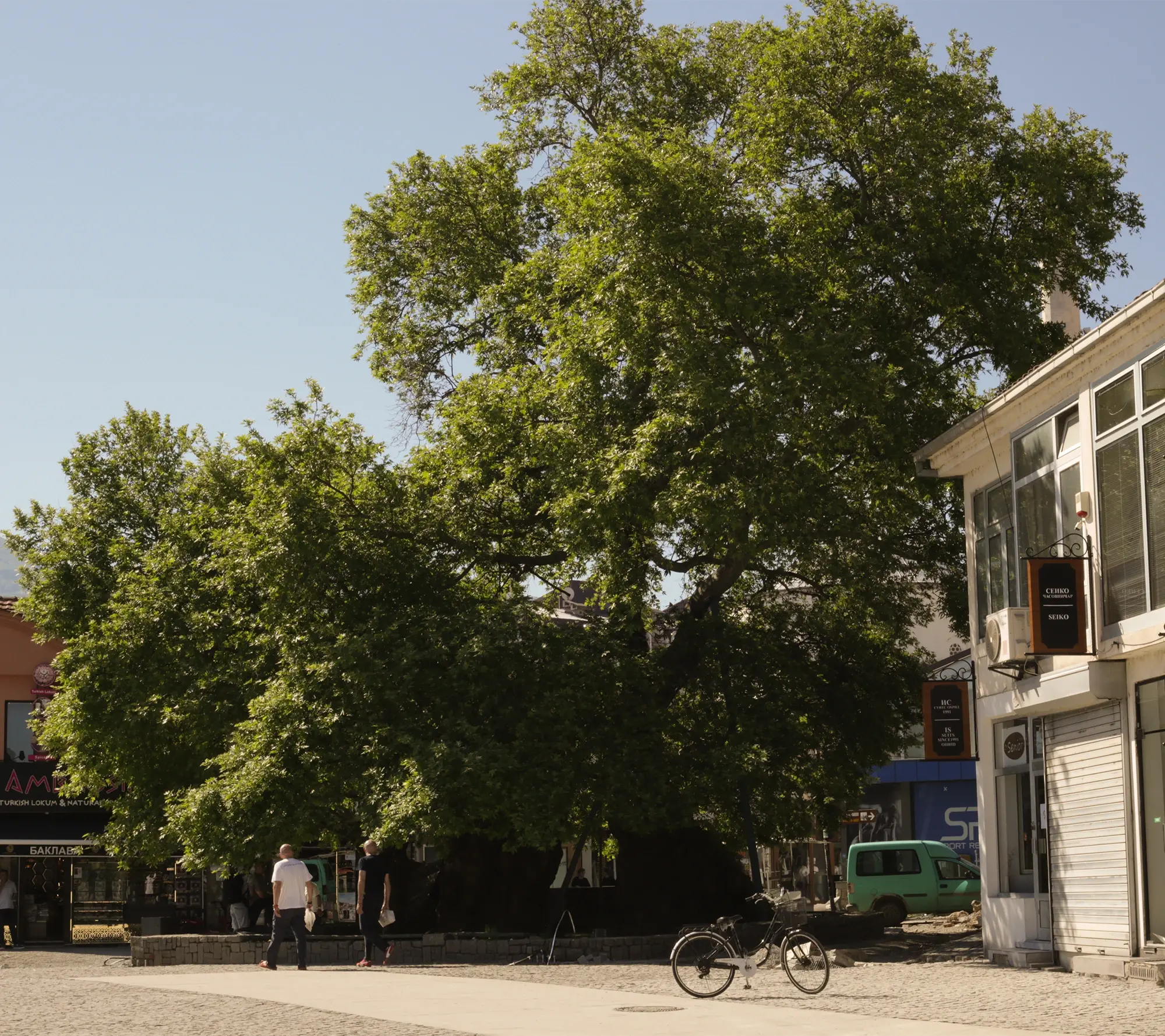
There is a tree in the middle of Ohrid that has been standing in the same spot since the ninth century. The tree has watched empires rise and fall. It has seen the Ottomans arrive, set up shop, and leave. It has witnessed the first pharmacy in town, the first coffeehouse, the first post office. For centuries, the tree has listened gossip, love confessions, political announcements, and, if the historians are to be believed, the odd public execution.
I am, of course, talking about the Činar.
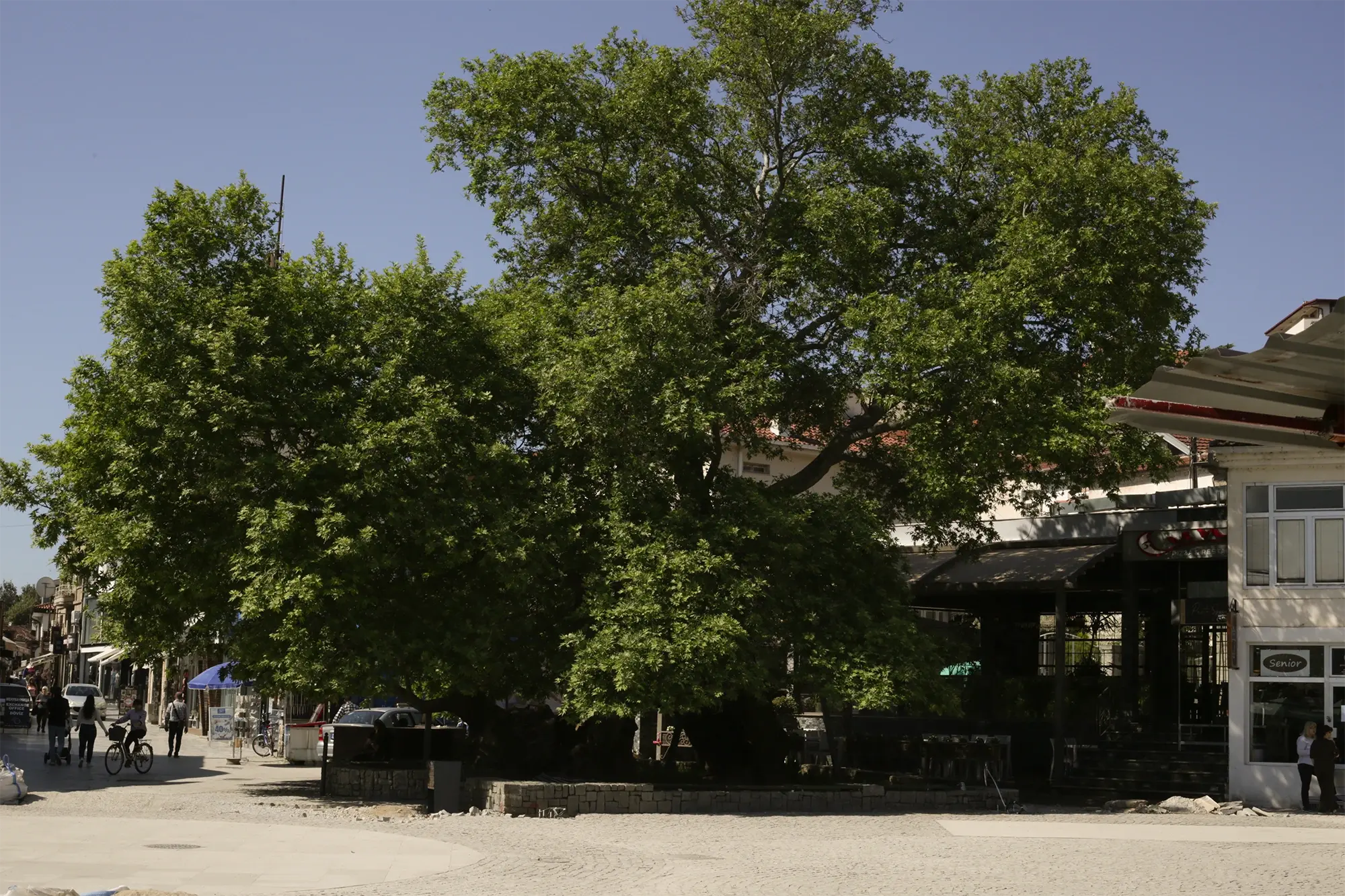
If you walk through Ohrid's Old Bazaar and feel a sudden drop in temperature, a gentle rustle overhead, and a vague sense that something very old and very wise is watching you, congratulations. You have found it. Or more accurately, it has found you. Because the Činar, this ancient Oriental plane tree rooted at the heart of the city, has a way of making you feel like the visitor in its story, not the other way around.
A Tree of Remarkable Proportions
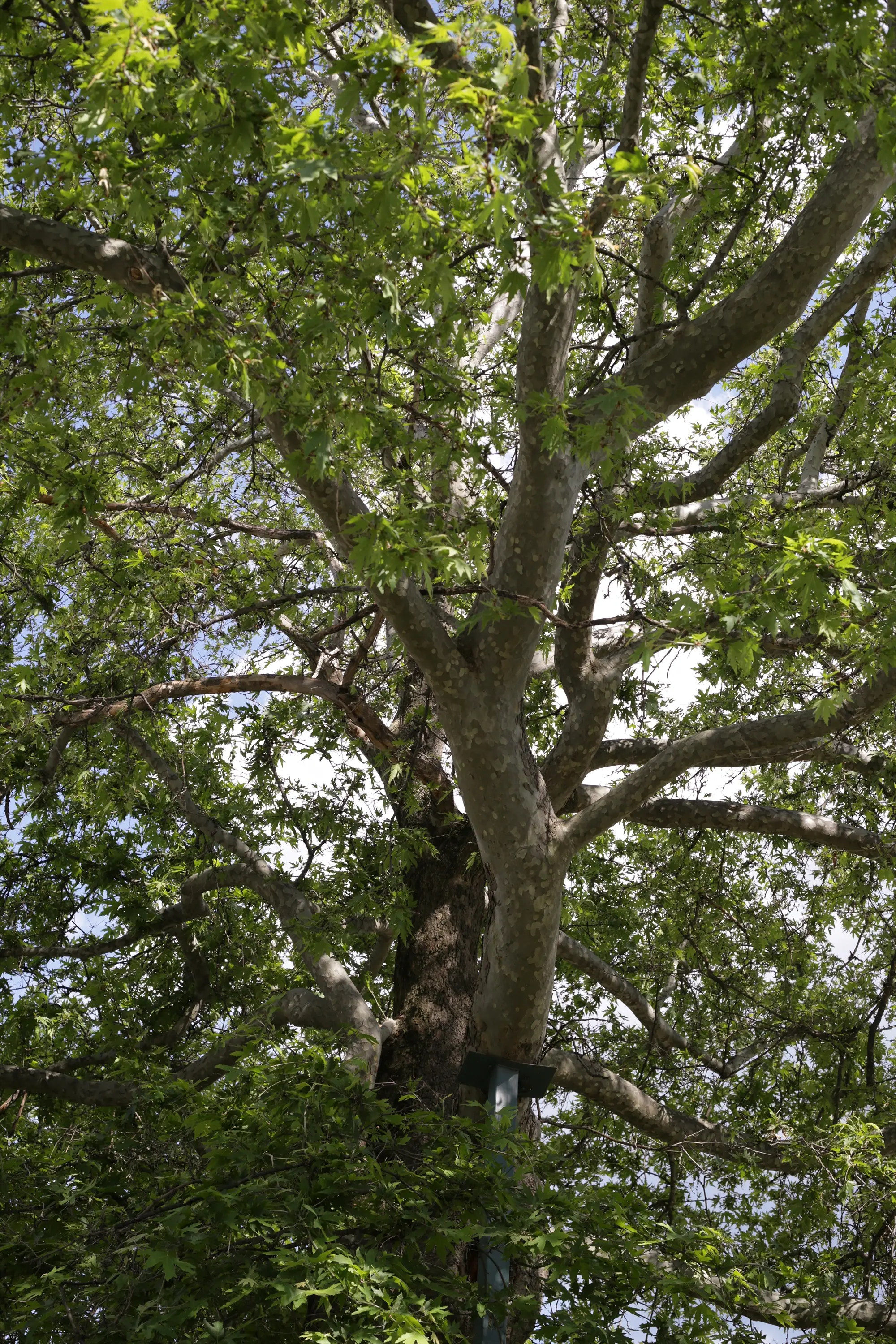
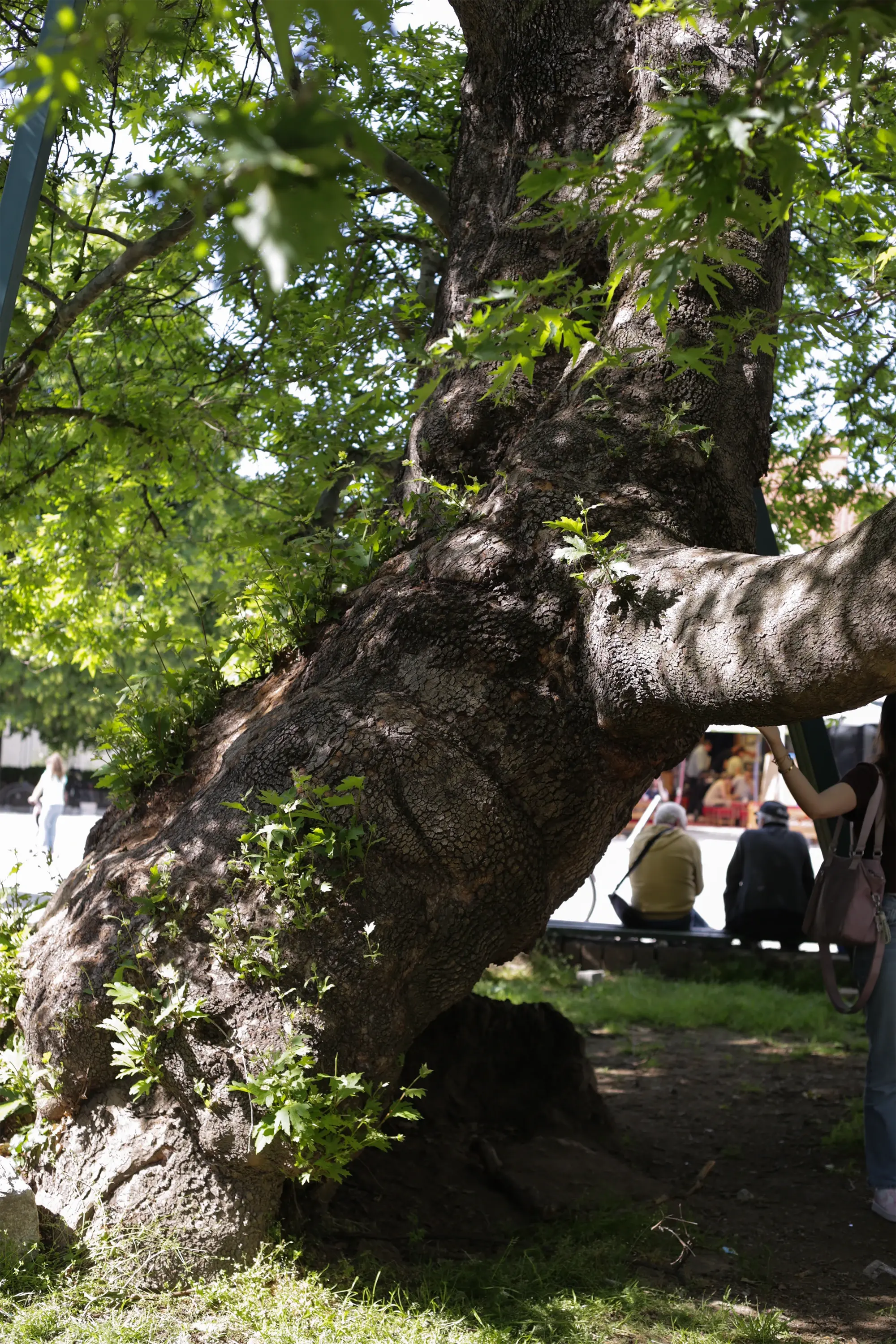
The Činar stands 25 metres tall. Its trunk circumference, measured at chest height, is a staggering 18.80 metres. The root system spreads to a circumference of 26.7 metres. The canopy stretches 16.40 metres from east to west, and 12.60 metres from north to south. The shade it casts covers more than 200 square metres.
Two hundred square metres. That is roughly the size of a generously proportioned two-bedroom apartment, except instead of walls, you have branches, and instead of a ceiling, you have a living canopy that has been filtering the Ohrid sun for over a millennium.
For botanists, this is a specimen of extraordinary rarity, not just in North Macedonia but across the entire region. A plane tree of this age and dimension is, put simply, almost impossible to find. For the people of Ohrid, the tree has always been something harder to name with precision. A symbol. A guardian. A clock that does not count hours, but centuries.
According to legend, the Činar was planted by Saint Clement of Ohrid himself, the patron saint of the city, scholar, missionary, and the man responsible for much of what made medieval Ohrid one of the most important intellectual centres of the Slavic world.
Science, pleasingly, does not entirely contradict the legend. Studies have confirmed that the tree's age aligns closely with the period of Saint Clement's arrival in Ohrid, around the end of the ninth century. So while no historian will sign off on the claim that Clement personally pressed this particular seed into this particular ground, the timeline holds.
Eleven Centuries of Stories
The Činar's oldest stories are the hardest to verify and the easiest to believe. Under its branches, travellers quenched their thirst. The sick came looking for relief. Lovers sighed into the shade.
Mothers wept. The Činar heard all of it and said nothing, which is, when you think about it, exactly what a good listener should do.
But as we move into the more recent centuries, "recent" being a relative term when we are talking about a tree older than most countries, the stories become wonderfully specific.
Vasil and His Pliers
In 1900, at the very dawn of the twentieth century, Ohrid's first pharmacy opened beneath the Činar's canopy. Legends say that the pharmacist's name was Vasil. From everything recorded about him, Vasil was a man of remarkable confidence and rather flexible professional boundaries.
People came to Vasil for all manner of ailments. He dispensed remedies, offered advice, and, in what was apparently considered a perfectly reasonable extension of pharmaceutical service, he also pulled teeth. With regular pliers. The kind you would ordinarily find in a toolbox.
There were no injections. No anaesthetics. No sterilisation. What there was, however, was komovica, a strong grain rakija, which served simultaneously as anaesthetic, disinfectant, and, one suspects, psychological preparation for both patient and practitioner.
When Vasil died, the pharmacy closed with him. But the Činar did not stand empty for long.
The Coffeehouse Under the Canopy
Shortly after Vasil's departure, someone had the excellent idea of placing a few wooden tables and chairs in exactly the same spot. And just like that, a kafana was born.
The agas and the beys, the local Ottoman-era nobles, came here for coffee and tea and what the Macedonian chronicles describe as laf muabет, which translates roughly as "good conversation" and more precisely as the kind of leisurely, unhurried talk that fills an entire afternoon without anyone quite noticing where the time went.
Under the Činar, the kafedžija served and earned his keep, and the tree stood overhead and listened to the gossip of a city that did not yet have newspapers.
The Fountains and the Water Carriers
In the days before Ohrid had a proper water supply, when drinking water had to be drawn from the lake itself, the Činar was the site of four fountains with eight spouts. Cold, clean water piped through ceramic pipes all the way from a spring called Bejbunar.
The bavčandžii , the market gardeners, and the day labourers who worked the fields in the surrounding neighbourhoods would stop here on their way back into town, and they were very particular about the order of operations: people first, then livestock.
The horses and donkeys, who were the only vehicles anyone had at the time, would wait their turn with what I imagine was the patient dignity of animals who understood they were in a rather nice spot.
Letters to the World
At the beginning of the twentieth century, Ohrid's first post office was established near the Činar, where the current commercial centre now stands. From beneath the shade of those ancient branches, letters left for the world, and word came back. Good news and bad. Births and deaths. News from the cities. Love letters. Official notices. All of it passed through this corner of Ohrid, filtered through the atmosphere of a tree that had seen much stranger things.
The Bus That Squeezed Through
If you visit the Old Bazaar today and try to imagine a bus navigating its cobblestoned narrowness, you might think I am joking. I am not. In the 1960s and 1970s, the road that ran beneath the Činar was one of the city's busiest arteries, and buses did indeed pass through, lurching and squeezing along the stone-paved lane that connected the bazaar to the road toward Struga.
On Mondays, when Ohrid held its weekly market, the street became gloriously, chaotically busy. Monday is still the market day in Ohrid to this day.
Vendors, shoppers, tourists, animals, and the occasional startled bus all competed for space in a lane that was really only designed for one cart at a time. The Činar watched all of this with its customary equanimity.
The Last Goodbye
There was a custom in Ohrid, poignant and quietly beautiful, that speaks to how central the Činar was to the city's sense of itself. When someone died, the funeral procession would pass by the Činar on the way to the cemetery. It was a symbolic farewell, a chance for the departed to say goodbye to the heart of the city one final time before leaving it forever.
The Noticeboard of the Ottoman Empire
Under Ottoman rule, the Činar served a more official purpose. When the authorities wanted to communicate with the population, new laws, additional taxes, any change in how the raya (the non-Muslim subjects of the empire) were expected to live, announcements were posted at the Činar. Everyone knew where to come for news, official or otherwise.
It also, on darker occasions, served as the site of public executions. The tree, I suspect, did not enjoy this chapter of its biography. But it endured it, as it has endured everything, and it is still here, and the empire that ordered those executions is long gone.
Among the young people of Ohrid, there was a saying that became shorthand for a particular kind of urban curiosity: "Aj da ojme da vidime da ne panal Činarot" — "Let's go see if the Činar has fallen." It meant, of course, let's go see what's new in town. The tree was the city's informal news hub long before anyone thought to invent the internet.
Not the Only Činar in Town
Here is something that surprises many visitors: the famous Činar on the square is not the only one of its kind in Ohrid. The city has several of these ancient plane trees, scattered across different neighbourhoods, each with its own age and story.
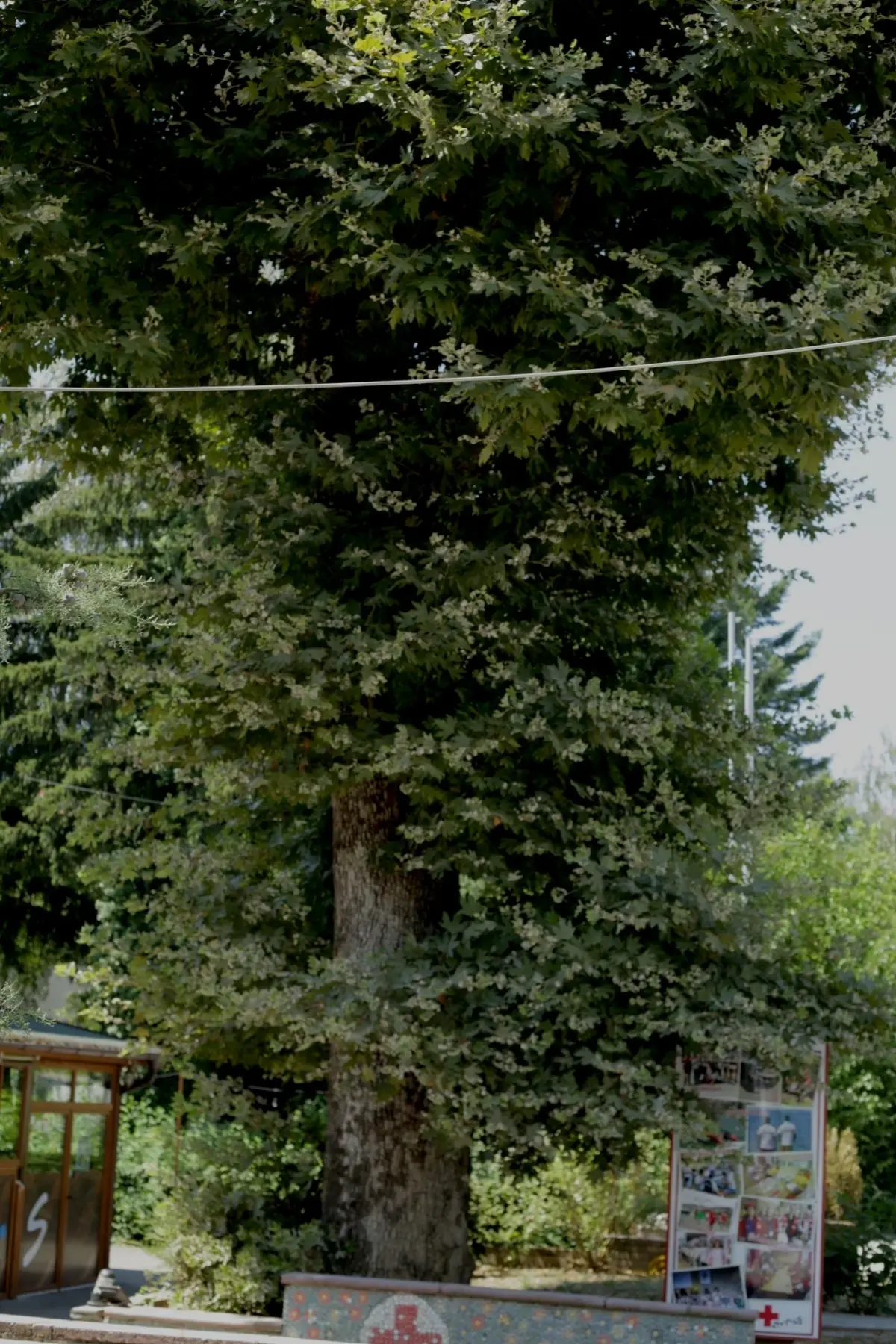
Near the Voska neighbourhood, another činar stands at approximately 400 years old. In Košišta, there is one around 300 years old. Vlaška Maala has one at 150 years, and near the local mini market, another at 120. Two more, in front of the Red Cross and the Pensioners' Association, have been standing for about a century each.
And then there is the Kočeđikot, a different tree, not a činar, but worth mentioning. It was planted in 1886 by one Nikola Čudov to commemorate the 1,000th anniversary of the death of Saint Methodius, co-creator of the Glagolitic alphabet and older brother of Saint Clement. Even the commemorative tree is over 130 years old.
A Natural Rarity — Official
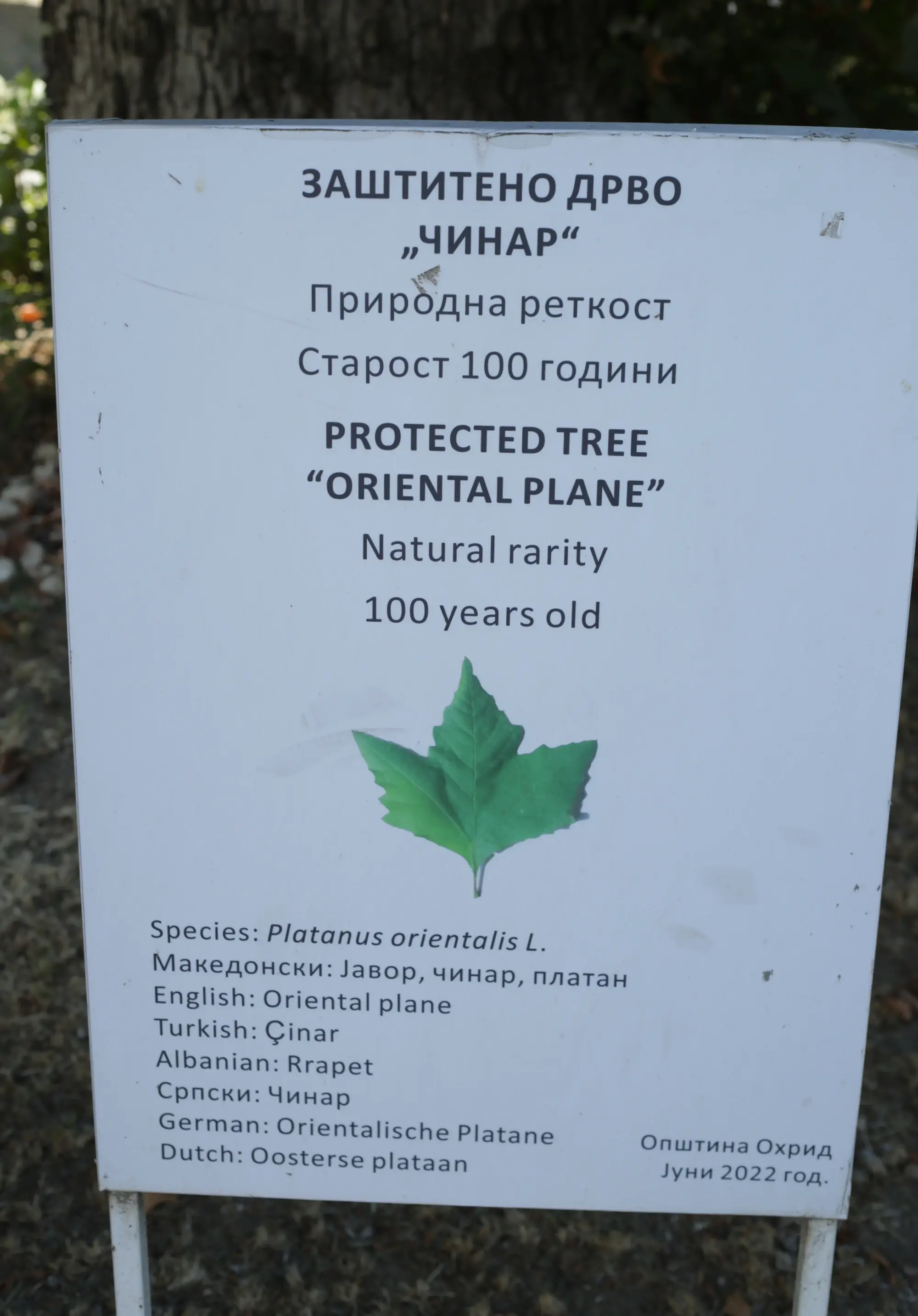
In 2019, the Macedonian Ministry of Environment made it formal. By decision of Minister Naser Nuredini, the plane tree on Činar Square in Ohrid's Old Bazaar was officially declared a natural rarity. The declaration came after the municipality prepared a full elaboration for the tree's valorisation, sanation, and revitalisation, and the City Council voted in support.
The tree's official name, in the way that living monuments get official names, is now simply: Činar – Ohrid.
It has been damaged by storms more than once in recent decades. Branches have fallen with age. But it endures, as it always has, patched and tended and standing in the same spot it has occupied.
Why Everyone Wants to Know Its Age
Talk to any tour guide in Ohrid and they will tell you that the Činar is one of their most reliable conversation-stoppers. Not because it is the most dramatically beautiful thing in a city that has no shortage of dramatic beauty, but because of the simple, almost philosophical weight of the number.
When they tell visitors that there is a tree here that is over a thousand years old, and that it is still alive, you can see the moment it lands.
Visitors from Western Europe are stunned. Visitors from East Asia are stunned. Everyone is stunned.
It makes sense when you think about it. We can point at old buildings and old bridges and old paintings. But a living thing that has been breathing the same air above the same piece of ground for a thousand years is something different. It refuses to be merely historical. It insists on being present.
There is also talk, among local tourism thinkers, of establishing a dedicated činar walking tour, a route connecting the old tree on the square with the three others between the square and the Daljan neighbourhood, weaving in the surrounding history and landscape.
Holy Thursday, Young People, and the Tradition Nobody Can Quite Agree On
There is another legend about the tree, some agree on it, others do not. The Činar has a special role every year on Holy Thursday. Every spring, as the city holds its breath between Good Friday and Easter Sunday, young people gather beneath these branches and then set off together to visit the Orthodox churches scattered across Ohrid's old streets.
The tradition is called Palikosa. And this is where things get interesting.
Holy Thursday and Good Friday are, in the Orthodox calendar, the heaviest days of the year. Thursday marks the Crucifixion, Friday the burial. In the old custom, the faithful would eat nothing on Good Friday — a fast not just of food but of noise, of festivity, of anything that might seem like it was not taking the grief of the season seriously. These are days of candlelight and quiet and the low hum of liturgy.
Some people consider the event unchristian, and more like something pagans would do. Paganism has been present among the youth for years.
The Činar Today
The spot has not lost its gift for gathering people. It is still, without any official designation or tourist board mandate, the place where everyone ends up.
Sit under the Činar on a summer afternoon and you will find yourself in excellent company: a grandmother on a bench, a group of teenagers performing the ancient ritual of hanging about, a tourist taking a photograph of the fountains that still run beneath the trunk, a local having an unhurried coffee. The fountain is still there. The shade is still magnificent.
The Old Town presses in from all sides — the church spires, the cobblestones, the smell of pastrmka grilling somewhere nearby. And over all of it, the Činar spreads its canopy in that proprietary way it has, like a host who has been welcoming guests since the ninth century and sees no reason to stop.
If you are doing the Old Town on foot, and you absolutely should be, because Ohrid's Old Town is not the kind of place that reveals itself from a car window, the Činar is the natural midpoint. Rest here. Let the shade do its work. Look up into the branches and try, if you can, to count the seasons that have passed through them.
You will lose count quickly. That is fine.