Three cities believe Gomleze is their specialty. Ohrid lays claim on it, Struga, and people in the Prespa region as well. In Ohrid, Gomleze has deep roots within the community. People pass on the recipe from one generation to another.
Some might say it is like a pancake. But gomleze is what a pancake spends its whole life trying to become.
Preparation has strict rules, not only about the ingredients, but about the process of making as well.
What is Gomleze?
Gomleze goes by several names depending on who's making it: gomlezec, turi-potpechi, kashanik. All point to the same dish, a thick, layered flatbread baked outdoors under a metal dome lid called a sach.
The word originates from Turkish times, when Ohrid and Macedonia were part of the Ottoman Empire. In Turkish, the word “gözleme” means a thin wafer of layer.
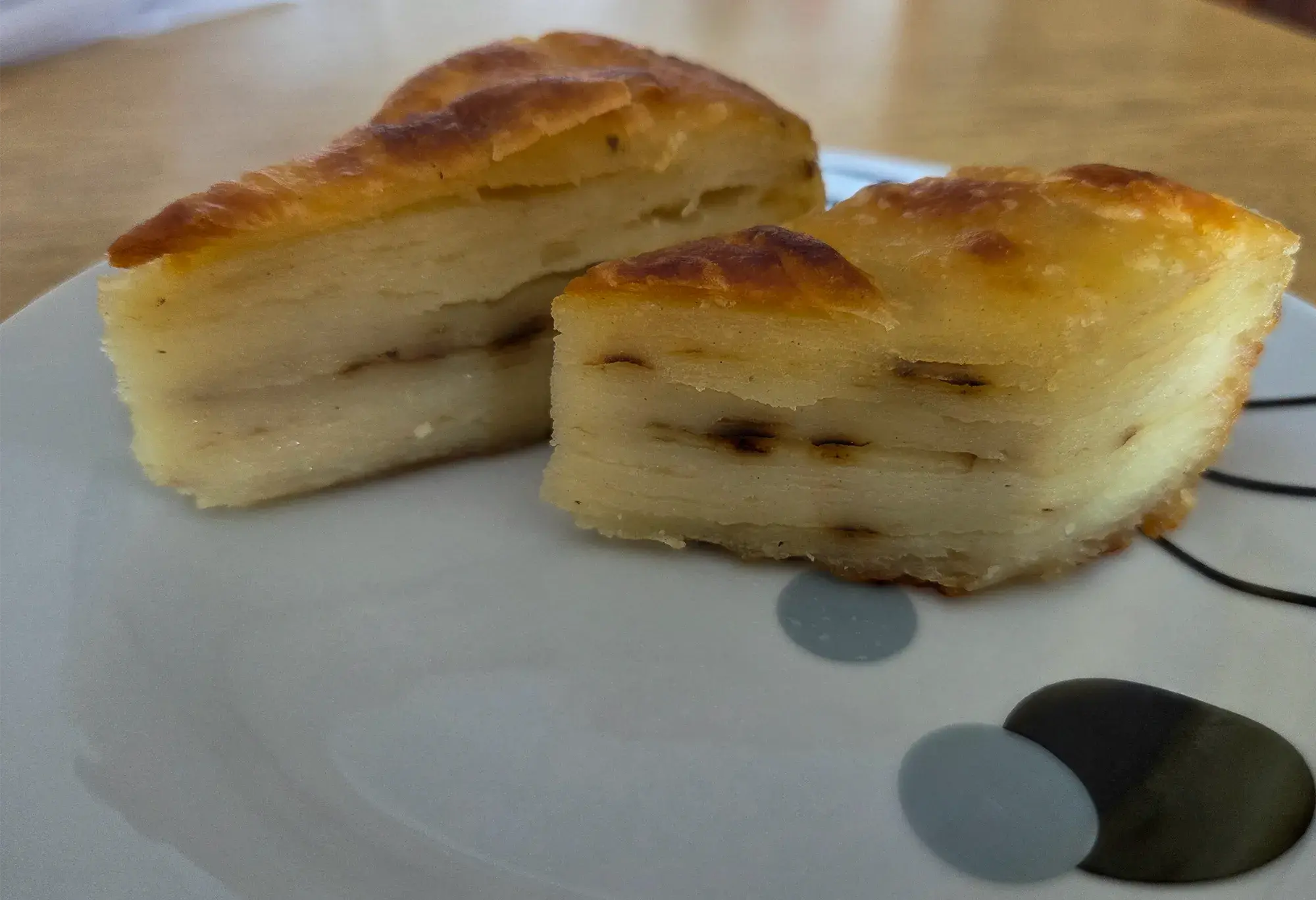
The moment you try gomleze, you understand its meaning. It is not a single loaf. What you get is dozens of thin layers of baked batter, stacked one on top of the other until the baking pan is full.
The ingredients are simple. Traditionally, just flour, water and salt, loosened to a batter roughly the consistency of pancake mix. Oil came later, brushed between layers to help them separate and crisp.
That is all that goes in, no yeast, no eggs, no hidden or secret ingredients. But the simplicity is what makes the dish so hard to pull off well.
Today, gomleze carries a status symbol, considered a specialty in Ohrid cuisine.
Whose Dish Is It, Really?
Ask someone from Ohrid and they'll tell you gomleze is theirs. Ask someone from Struga and you'll get the same answer, just with more conviction. Then someone from the Prespa region will lean in and remind you both that they've been making it just as long.
The reality is nobody wins the argument. All three regions prepare it in an identical way. The difference comes to the ingredients list. And let’s be honest, what changes from one town to another is not the method of preparing. It is who tells the story with more pride.
Prespa's version does have one genuine distinction, they add batter alongside the standard flour, water, and salt. Then, they also add yogurt and yeast, which gives their gomleze a softer, and slightly tangier taste compared to the drier Ohrid version.
Gomleze – The Recipe
At first glance, gomleze might sound like a simple recipe. Flour, salt, and water. But this dish requires hours of preparation. And that is what separates gomleze from other baked goods in Macedonian cuisine.
The process starts early, often at dawn, because it genuinely takes the better part of a day. Two liters of water dissolve roughly two kilograms of flour into a batter, salted to taste. A wide baking pan, the “tepsija”, goes onto a trivet over an open flame to heat through. Traditionally that flame burns kindling rather than split logs, a detail Ohrid families are particular about.
Once the pan is hot, it gets a splash of oil, then a single measure of batter, then a heated dome lid goes on top to bake that first thin layer. A few minutes later, the lid comes off, more batter goes in, more oil gets brushed on, and a second heated lid (most households keep two in rotation, one always reheating while the other works) seals in the next layer. Then it happens again. And again. Layer by layer, what locals call "guba po guba," until the pan can't hold any more.
Heat management is the key to a successful recipe. The dome lid has to be properly hot, or the layer just dries out instead of baking through.
Once the pan is full, the gomleze gets cut into pieces right there in the tray, covered one final time, and left to finish under embers piled both above and below for another 40 minutes or so.
The process demands patience, a hot fire tended for hours, and usually more than one set of hands. Many people can knead and roll dough. But making gomleze requires right setup, right heat, and a willingness to stand over an open flame for the better part of a morning. That's exactly why not everyone takes it on.
Simple Dish, Amazing Taste
Think pancake, but much better. The mistake many tourists make is they slice it like a cake. The right way to eat gomleze is layer by layer.
The outer layer is usually faintly bronzed, which is a testament to the smoke form the fire underneath it. The texture changes after the first layer, with the layers softer, almost custardy. The oil between each layer turns the dough slick, rather than dry.
Think of it this way. Gomleze is bread that somehow learned to be silk.
Chew slowly to savor the layers.
Where to Eat Gomleze in Ohrid
You don't need a wood fire or a spare relative to try it. Restaurants across Ohrid list gomleze as a house specialty, almost always served warm alongside a wedge of sheep cheese, which cuts through the richness of all that baked, oiled dough. Expect to pay somewhere between 100 and 150 Macedonian denars for a restaurant portion, plus the price for the cheese.
For an everyday version, several bakeries around the city sell gomleze by the slice for 40 to 60 denars, no reservation or sheep cheese pairing required.
It's the same dish, the same layers, and on a walk through Ohrid's old town, it makes a fairly perfect midday stop.