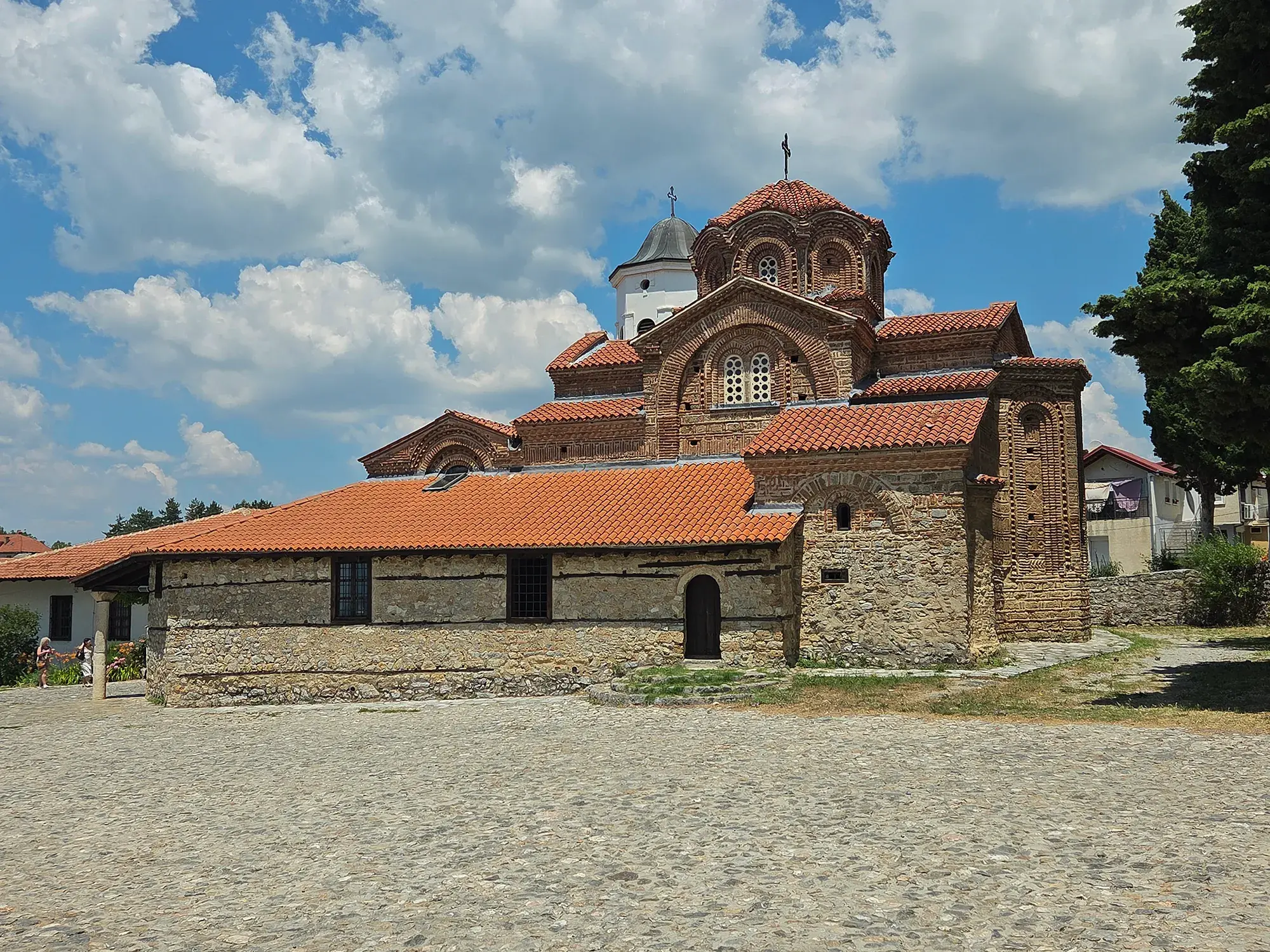
Somewhere in the climb through Ohrid's old town, the tourists thin out, the souvenir shops drop away, and the stones underfoot get older. You are heading uphill toward the terrace of Deboj hill, following a path worn into the rock over seven centuries. When the church comes into view — compact, elaborately decorated, standing in its walled courtyard above the lake — it takes a moment to accept that something this intact has been sitting here since 1295.
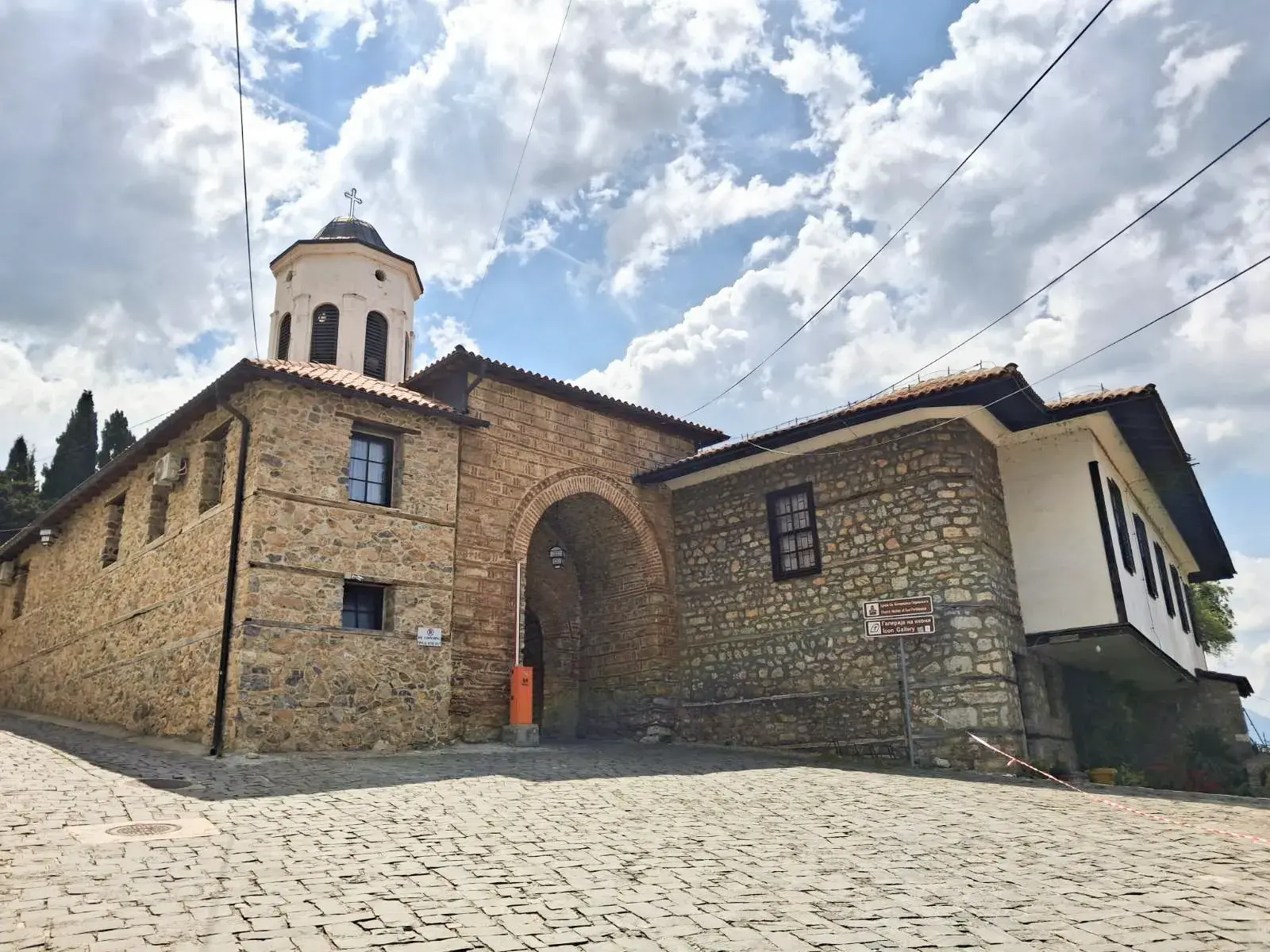
The Church of the Virgin Mary Peribleptos is not Ohrid's most immediately imposing medieval church. Sv. Sofija is larger. The churches of Plaoshnik command a more theatrical setting. But Perivlepta holds more history per square meter than either of them: it has served as a seat of church power, a hiding place for sacred relics, and the site of a declaration that reshaped Macedonian religious life. In the courtyard, a poet who won a literary prize in Athens writing in Greek lies buried in a city where almost nobody reads Greek anymore.
A Name Worth Knowing
The name "Perivlepta" is an ancient Byzantine epithet for the Virgin Mary.
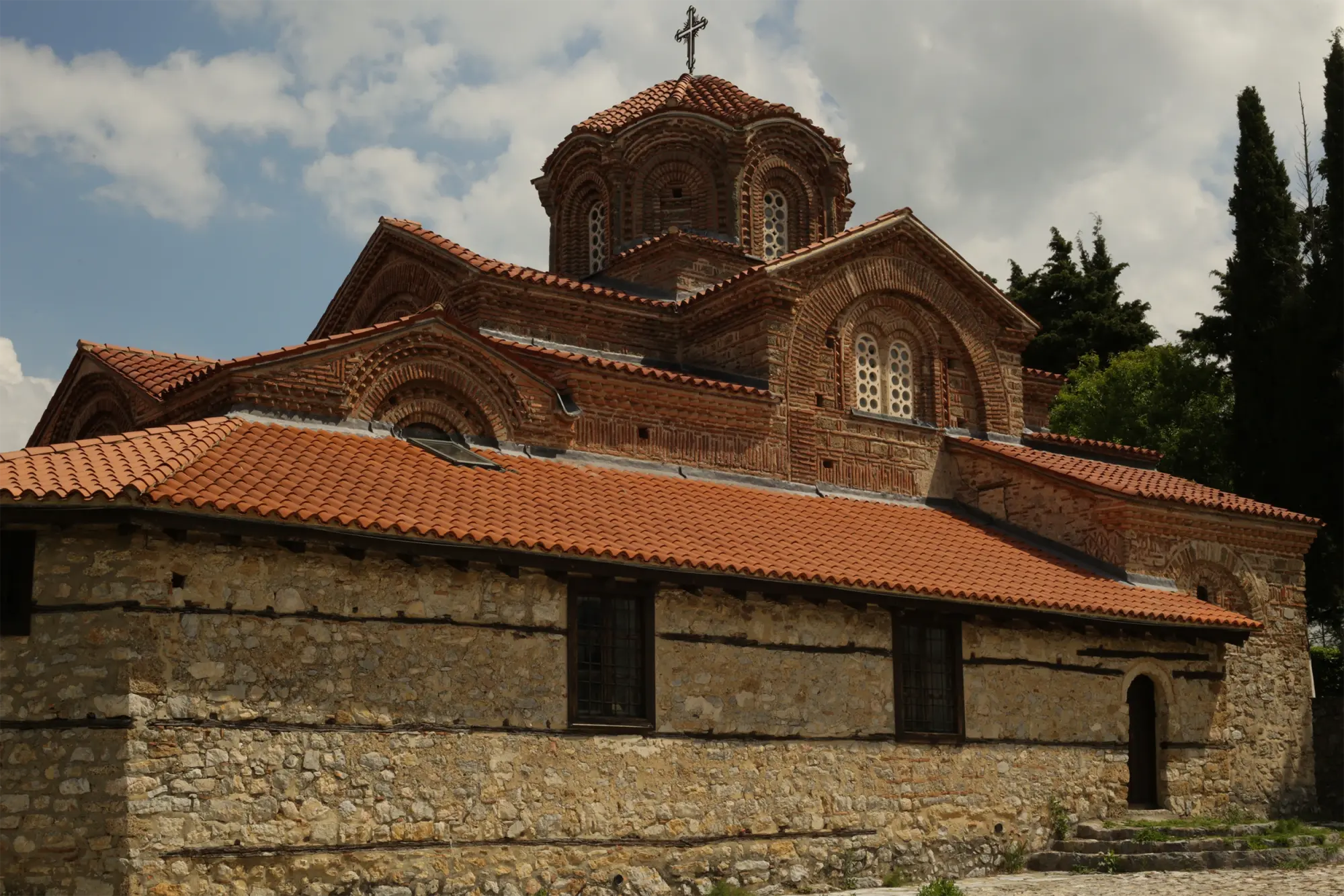
The exterior is built from alternating rows of stone and brick, but the masonry is almost beside the point. The facade is covered in ceramic inlay — meanders, crosses, diamond shapes, zigzag lines, blind niches framed by decorative arches — creating a textile effect, as though the wall has been embroidered rather than built. Byzantine architects called this technique ceramoplastics, and the idea was deliberate: to dematerialize the surface, to make the wall feel not like stone but like a veil between the outside world and whatever was happening inside. In morning light, it works.
The Frescoes
Above the western entrance, an inscription confirms the year: 1295. The church was commissioned by Progon Zgur, a Byzantine court official and relative of Emperor Andronikos II Palaiologos. The painters he hired — Mikhail and Evtihij — signed their names in ten places inside the church.
As far as scholars have established, this was their first major commission. They would go on to define what art historians now call the Palaeologan style of Byzantine fresco painting.
The frescoes cover the walls: the Dormition of the Virgin, the Communion of the Apostles, scenes from the Passion cycle. What separates them from earlier Byzantine painting is harder to name than to see — a softness in the faces, a psychological weight, a sense that the depicted figures are thinking rather than simply representing something. Art historians have spent careers parsing it.
A second round of frescoes was added in 1364–65, commissioned by Bishop Grigorij of Devol and painted by Jovan Teorijan. His work covers the chapel walls and the exterior of the narthex, with a Last Judgment on the southern facade and the Acathist Hymn to the Virgin on the northern one. On the western facade of the southern chapel, a tsar, an archbishop, and several feudal lords stand rendered in paint — a fragment of medieval Balkan politics that has survived seven centuries of weather.
Seat of the Archbishopric
When the Ottomans converted Sv. Sofija into a mosque in the 16th century, the Archbishopric of Ohrid moved here. For roughly two hundred years, Perivlepta served as the seat of one of the oldest and most influential church jurisdictions in the Orthodox world — one that stretched, at its peak, across much of the Balkans.
The church held the relics of St. Clement of Ohrid, one of the missionaries who brought literacy and Christianity to the Slavic world. Those relics were kept here for centuries before returning to Plaoshnik in 2002. The association with Clement ran deep enough that the church acquired a second name — Sv. Kliment — which many locals still use today.
Then there is July 18, 1967. That is the date when the Holy Archiepiscopal Synod met here and proclaimed the autocephaly of the Macedonian Orthodox Church, its independence from the Serbian Orthodox Church. One of the most consequential acts in modern Macedonian religious history took place in this courtyard, in this building on a hill above a lake. You can find a plaque that marks the event in the compound. Most visitors walk past it.
What Else Is in the Compound
The Icon Gallery occupies a reconstructed former stable and houses original Byzantine icons — not reproductions. Entry costs €2.50 for tourists. Open Tuesday to Sunday, 9 am to 2 pm.
The Bell Tower, built in 1923, gives the complex its vertical accent and a useful navigation point in the upper old town.
The grave of Gligor Prlichev sits in the courtyard — a simple marble-covered structure with a memorial plaque. Prlichev (1830–1893) was born in Ohrid and won a major literary competition in Athens in 1860 with an epic poem written in Greek, then spent the rest of his life writing in Macedonian and translating Homer. A shaded park bearing his name opens toward the lake.
Nearby stands a Kochejik tree, a protected natural monument planted in 1886 to mark a thousand years since the death of St. Methodius, co-creator of the Glagolitic alphabet that became the foundation for Cyrillic script.
The Church of Ss. Constantine and Helena occupies a quiet corner of the compound. Worth fifteen minutes.
How to Get There and Practical Info for Tousits
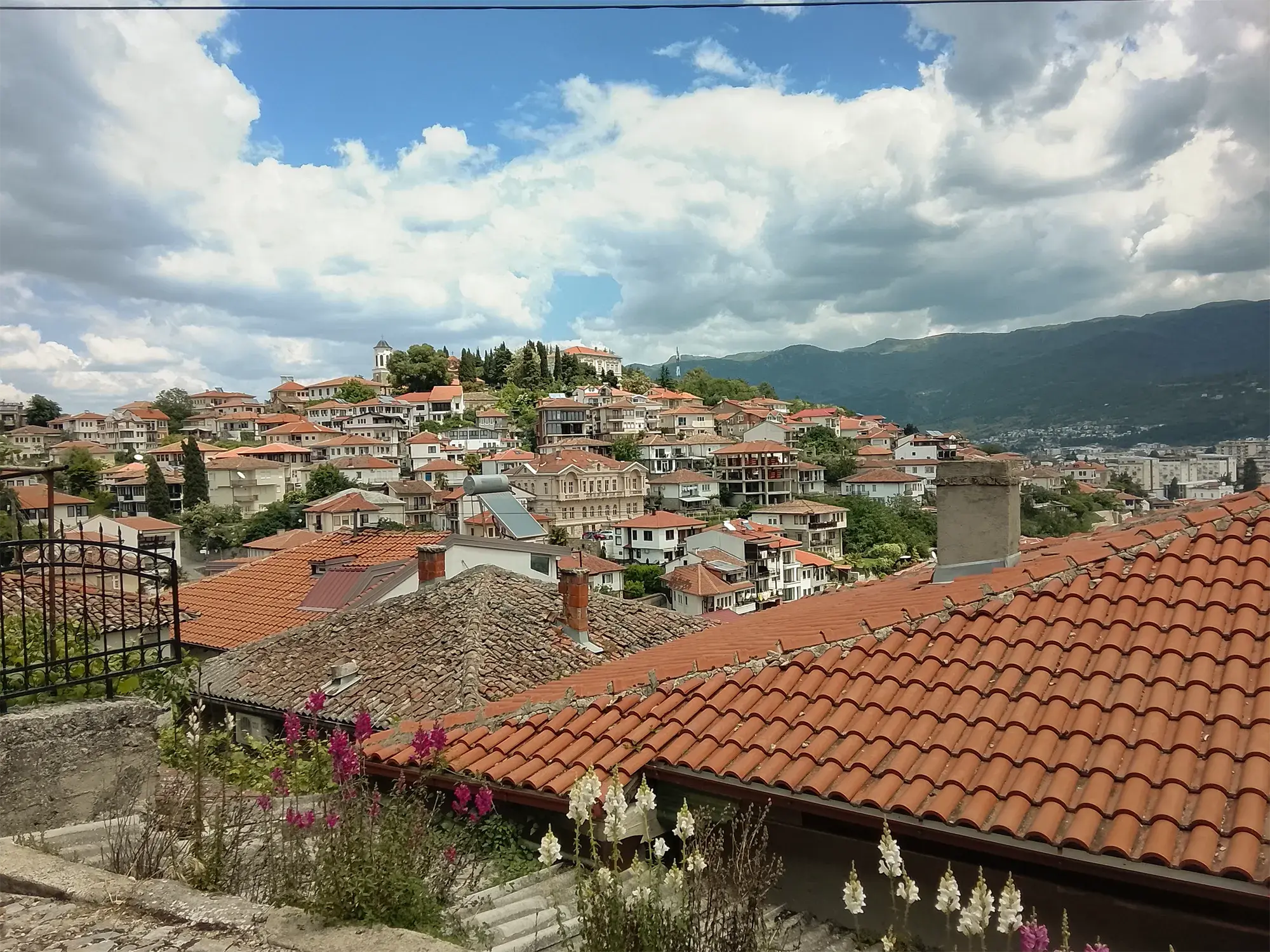
Perivlepta sits on the slopes of Deboj hill in Ohrid's upper old town, along the walking route connecting the old bazaar with the ancient theater and Gorna Porta (the upper gate). From Kliment of Ohrid Square, the walk takes 10–15 minutes uphill through narrow, uneven streets. No parking sits immediately at the church; limited spaces are available further down on Ilindenska Street.
Entry to the complex and church is free. The Icon Gallery charges €2.50 for tourists.
Perivlepta sits on the UNESCO World Heritage walking route through the upper old town and pairs naturally with the ancient theater, the Church of Sv. Jovan Kaneo, and the fortress above.