There is a place in Ohrid where you can sit on the same stone seat where someone sat two thousand years ago, watch a live concert under the open sky, and enjoy Lake Ohrid beneath you in its full glory.
That place is the Ancient Theater, and it might just be the most dramatic square meter of real estate in the entire Balkans. More than two thousand years ago, it hosted literal drama.
But let’s start at the very beginning.
The Greeks Built It
Back around the late 3rd or early 2nd century BC, Ohrid was called Lychnidos. The city was doing quite well for itself. It had culture, commerce, and, as any self-respecting ancient city needed, a proper stone theater.
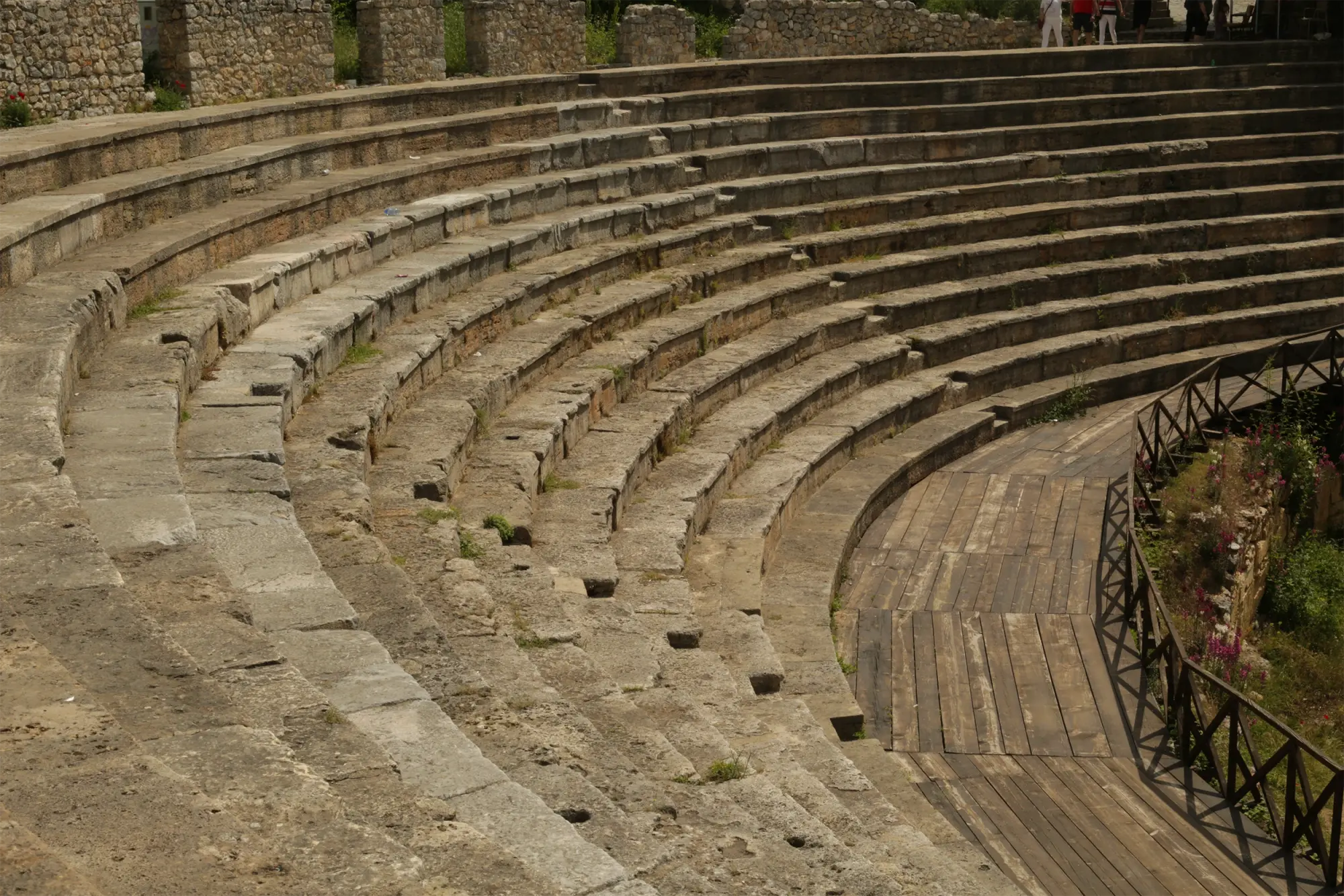
The theater was built in classic Hellenistic style, carved into the natural slope of the Ohrid hill right below what would later become Samuel's Fortress. The Greeks had a great plan, they allowed the hill to do the structural work, seat people on the hillside, and position the stage eastward so the audience would have the lake and the mountains as their backdrop.
Two thousand years before anyone invented the phrase "stunning venue," the architects of Lychnidos had already figured it out.
They decorated the stage building with bas-relief friezes depicting scenes from the lives of the gods. Two of those marble panels survive to this day and you can find them in the Ohrid Museum. They show Dionysus, the Greek god of theater, wine, and general festivity.
Reserved Seating: A Very Ancient Problem
What was true two thousand years ago, holds to this day. You will resonate with the story as you might have found yourself in a similar one.
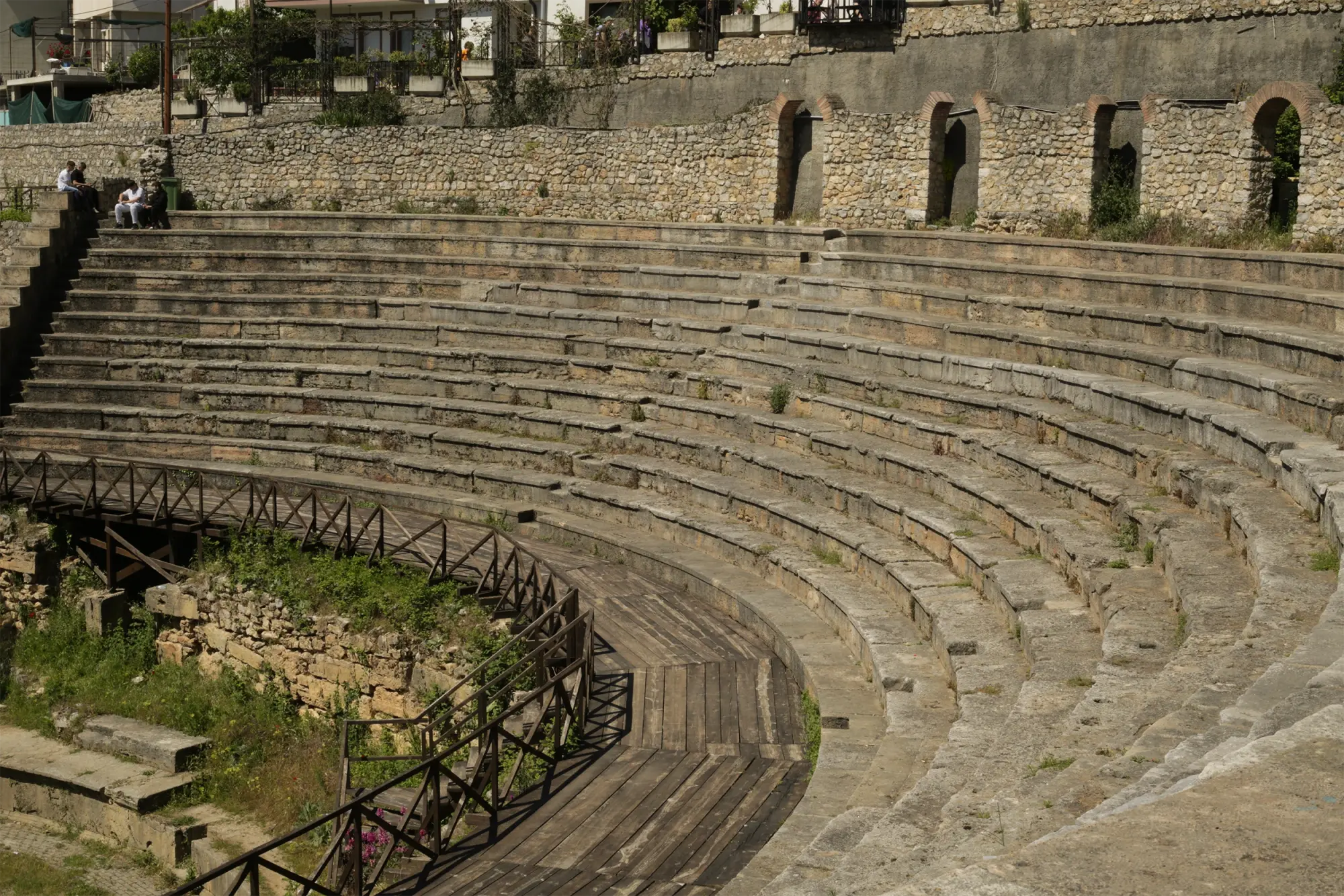
People back then also tried to claim the best seats. Some of the wealthier citizens of Lychnidos had their own seats permanently reserved in the theater. To ensure nobody could get their seats, they had their names carved directly into the stone.
Two of them, Crisp and Topos, stand to this day. Whatever they watched, Greek tragedies, comedies, or anything else, they watched from good seats.
There are also small holes drilled into the stone edges of the seating rows. Archaeologists believe these held wooden poles that supported awnings to shade the audience from the sun. Even in the second century BC, nobody wanted to watch a four-hour tragedy while getting sunburned.
And Then the Romans Arrived
In 148 BC, Rome conquered these territories and the theater got a significant remodel. The Romans, who found Greek drama a bit slow for their taste, decided to convert it into something more exciting: an arena.
The lower rows of seats were demolished to make room for animal cages built directly under the auditorium. They sealed the orchestra, the performance area, with a protective wall.
That is how the theater went from hosting Sophocles to fights between men and wild animals.
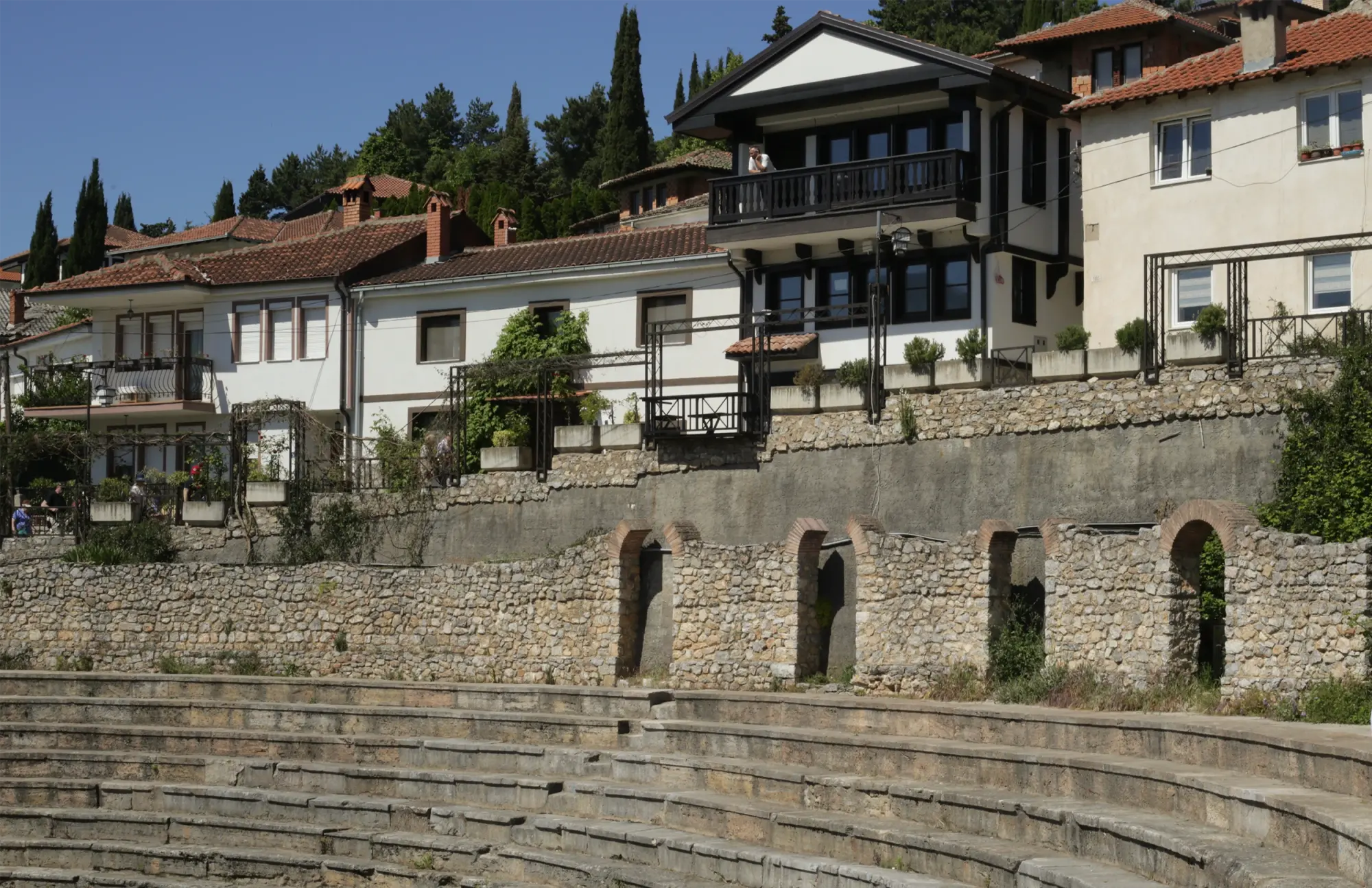
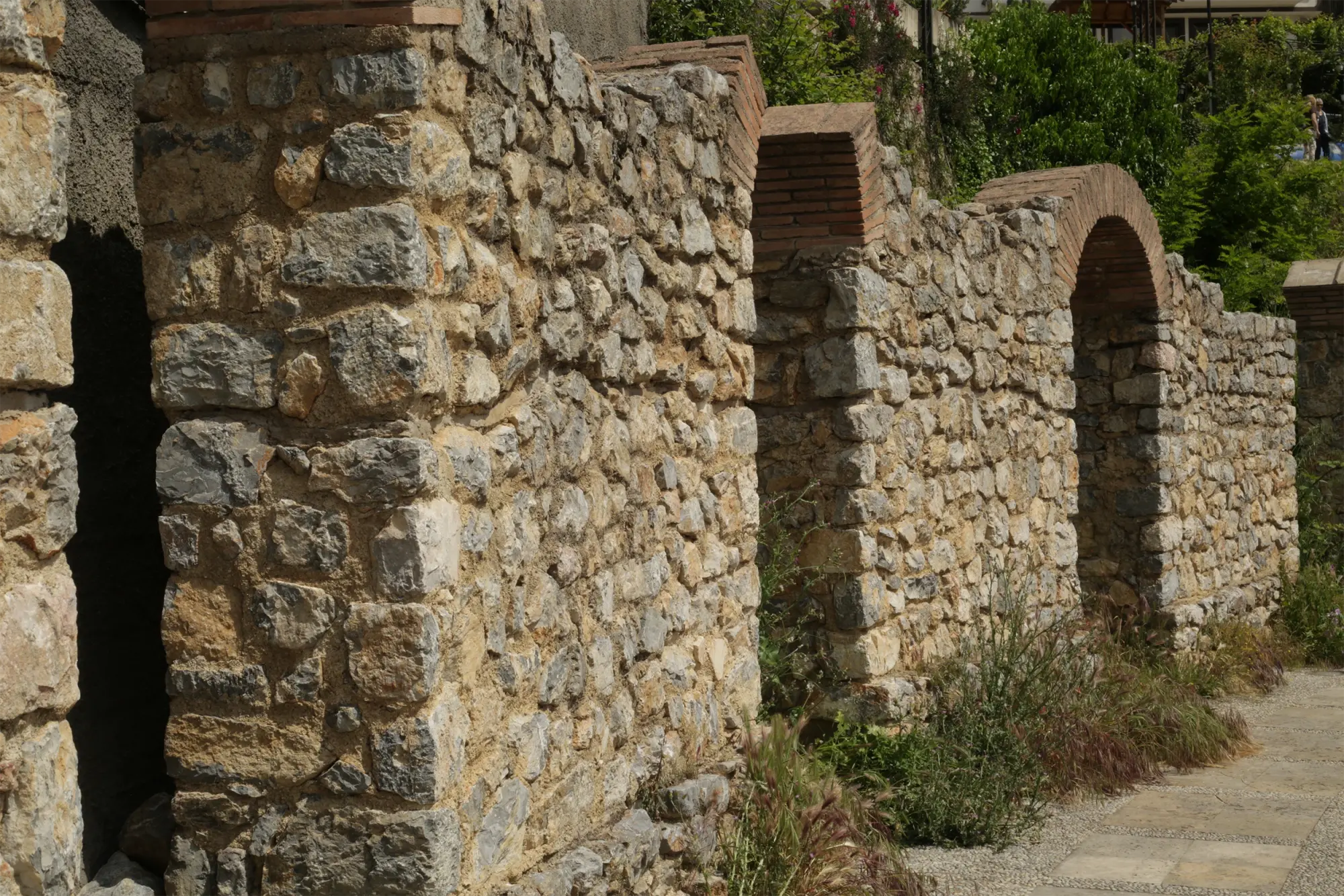
Even today, you can still see the passageways that led to those animal cages under the seats. The infrastructure for keeping lions or bears below the audience was apparently not that different from modern venues keeping beer kegs in the basement. Different vibe, though.
Later, the Romans added an upper extension called an "epitheathron" that pushed the total capacity up to 5,000 spectators.
The theater ended up being a hybrid: Hellenistic in its bones, Roman in its muscle. That shows in the architecture even today, the orchestra is slightly larger than a semicircle, which is neither purely Greek (fully circular) nor purely Roman (strictly half-circle).
This is what happens when two very different civilizations share the same building across a few centuries.
The Christian Era
In the early 4th century AD, a Christian missionary named Erasmus of Antioch arrived in Lychnidos and, by most accounts, had an extraordinary run. He reportedly converted 25,000 people to Christianity, which, for context, is an impressive number for a city of that era.
The new converts, as new converts sometimes do, destroyed everything that reminded them of the old ways. They tore down every pagan structure in the city they could find. They repurposed the stone for building early Christian basilicas.
For example, in the theater, the stage building vanished. The seats were stripped. In a few generations, one of the finest theaters in the region had been completely buried under the growing city.
There the theater sat for roughly seventeen centuries.
The Treasure Hunters
Long before any official archaeological work began, the local population of Ohrid knew that something interesting was buried on that hillside. They had occasionally stumbled across corridors and stone passages while building or digging. And because this is the Balkans, and because buried ancient structures and legendary treasure are inseparable in local folklore, some of them started digging tunnels.
Not for archaeology. For treasure.
They did not find treasure. They found, as it turned out, the underground corridors of an ancient theater. Which is arguably more valuable.
The first serious academic suggestion that a theater might be buried beneath Ohrid came from Russian art historian Nikodim Kondakov at the very start of the 20th century. The first actual excavations followed in 1935. They partially uncovered the theater. Further work in 1959 and 1960 pinned down the exact location and size. Then systematic excavations in 1977, paused for six years, and resumed in 1984, uncovered nine rows of seats and confirmed the scale of what was there.
It was only in 1999 that a full excavation and restoration project finally started, led by architects M. Tokarev and J. Aleksievska. By 2001, the theater was open again.
After twenty centuries. Which is a long intermission, even by Macedonian bureaucratic standards.
The Ivory Mask
While we are on the subject of things found in the theater: archaeologists also discovered a small ivory amulet at the site. It is a tiny mask, with the face of Comedy on one side and Tragedy on the other. It has a small hole in it, suggesting it was worn or hung. The most likely explanation is that it belonged to an actor from the ancient theater of Lychnidos.
Think about that for a second. Someone was carrying that little mask around while performing in this theater 2,200 years ago. It ended up in the ground. We found it centuries later. And now, it belongs in a museum in the same city where it was used.
The Theater Today: Drama Is Back, and So Is Music
In 2001, twenty centuries after the theater last had an audience, performances returned to the stage. And the crowds came back with them.
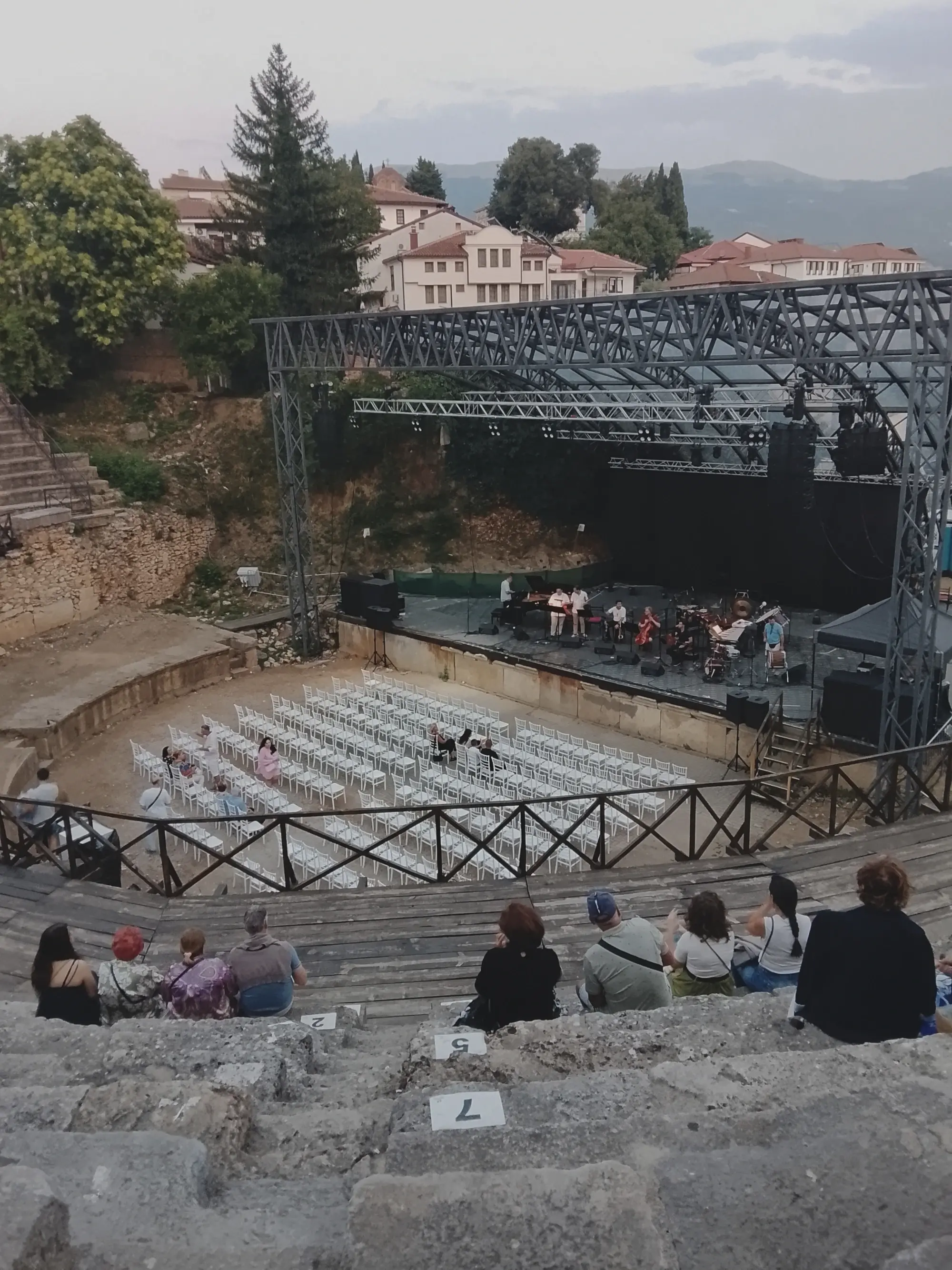
Today, the Ancient Theater is one of the most atmospheric open-air venues in the Balkans. Concerts, theater performances, and various cultural events fill the calendar from spring through summer. The setting does all the promotional work for you: stone seats that have been there since the Hellenistic era, the walls of Samuel's Fortress looming on the hill above, and views of Lake Ohrid stretching out to the south. No stage designer can compete with that.
The theater is a central venue for the Ohrid Summer Festival, Ohridsko Leto, the international arts festival that has been held in Ohrid every July and August since 1961. Classical music, jazz, opera, folklore, theater, the program has everything you want, and the Ancient Theater is one of its most cherished stages.
Sitting in those stone seats on a warm Ohrid night, listening to a symphony orchestra with the lake gleaming below you, is one of those experiences that sounds like a travel cliche until you actually do it, at which point you understand why people keep saying it.
Macedonian and international performers have all played here. The acoustics are genuinely remarkable, the theater was sited partly because two surrounding hills naturally amplify sound, a detail the original architects understood and the modern sound engineers still appreciate.
Getting There and What to Expect
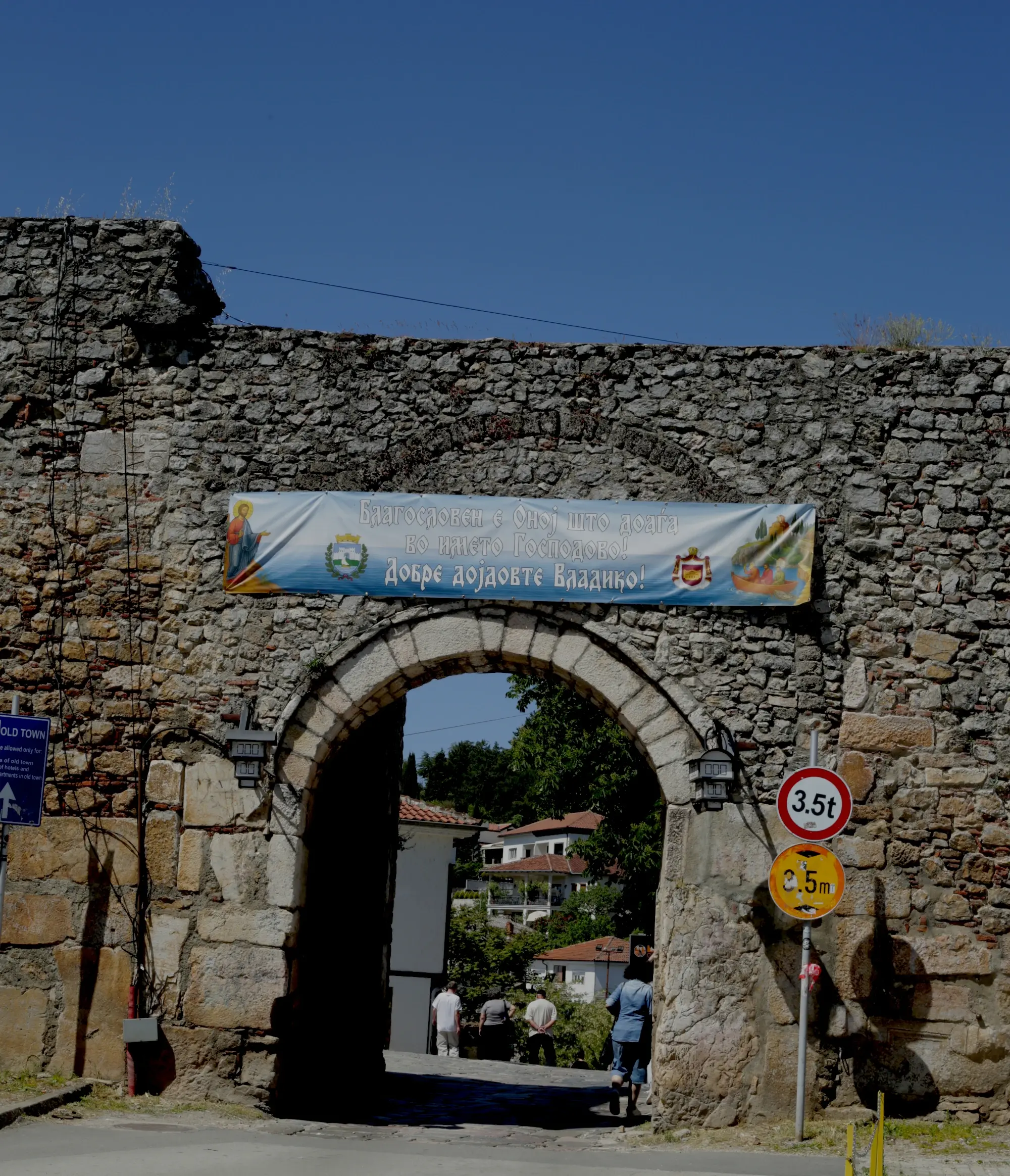
The theater sits just below the Upper Gate (Gorna Porta) of the old city, a short walk from the Church of Holy Sophia. The easiest way to reach it is to walk up through the old quarter from the waterfront. The climb is brief, and the streets are gorgeous. On your way up, you will pass enough medieval churches to feel deeply cultured before you even arrive.
Outside of event nights, the theater is open for visits and the views alone are worth the walk. Admission is modest. You can sit in the seats, look at the names still carved into the stone, peer into the passageways that once held animal cages, and try to imagine what happened here: Greek drama, Roman arena, Christian demolition, centuries of sleep, treasure hunters, archaeologists, and now, a Friday night jazz concert with 5,000 people under the stars.